Vinyl Record Sizes: Complete Guide to 7", 10" and 12" Formats

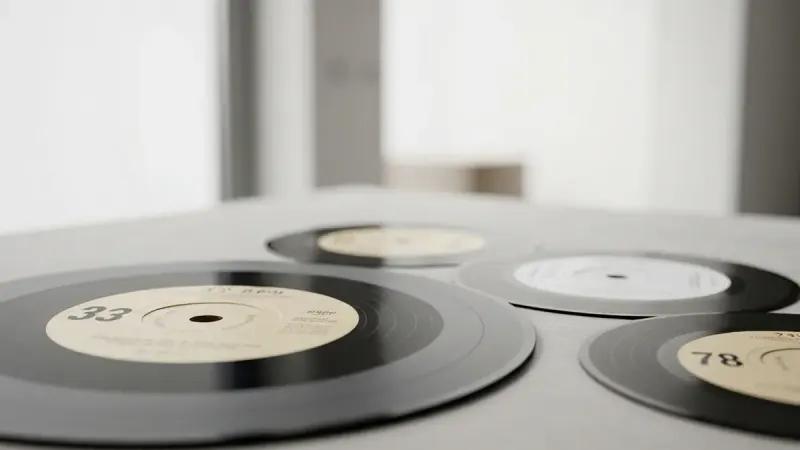
Les 3 points à retenir
- 112-Inch (30 cm) — The Album Format
- 27-Inch (17.5 cm) — The Single
- 310-Inch (25 cm) — The In-Between
Understanding Vinyl Record Sizes
Vinyl can seem confusing when you're starting out. 33 RPM, 45 RPM, LP, EP, SP, 7-inch, 10-inch, 12-inch, 180 gram... But the logic is simple once you understand the three parameters: size (diameter), speed (RPM), and weight.
The Three Main Sizes
12-Inch (30 cm) — The Album Format
The most common and iconic format. This is what you think of when someone says "vinyl."
| Spec | Detail |
|---|---|
| Disc diameter | 30 cm (11.89") |
| Sleeve size | 12.4 x 12.4" (31.5 x 31.5 cm) |
| Center hole | 7.24 mm (standard small hole) |
| Speed | 33⅓ RPM |
| Playing time | 20–25 min per side (40–50 min total) |
| Use | Albums (LP — Long Play) |
7-Inch (17.5 cm) — The Single
The historic single format — one or two tracks, the radio hit on Side A.
| Spec | Detail |
|---|---|
| Disc diameter | 17.5 cm (6.89") |
| Sleeve size | 7.1 x 7.1" (18 x 18 cm) |
| Center hole | 7.24 mm (small) or 38.1 mm (large, US/jukebox) |
| Speed | 45 RPM |
| Playing time | 4–5 min per side (8–10 min total) |
US 7-inch records often have a large center hole (38.1 mm) designed for jukeboxes. You'll need an adapter to play them on a standard turntable — most turntables include one.
10-Inch (25 cm) — The In-Between
The least common format today, but historically important. It was the standard before the 12-inch arrived in 1948. Now used for EPs (4-6 tracks) and special editions. Playing time: 12-15 minutes per side.
RPM Speeds Explained
- 33⅓ RPM: Album standard. Fine, closely-spaced grooves for long playing time.
- 45 RPM: Singles and 12-inch maxis. Wider grooves = theoretically better sound quality.
- 78 RPM: Pre-1948 shellac records. Fragile, heavy, ~3-4 min per side. Requires a special stylus.
Vinyl Weight: Does It Matter?
Standard: 120-140 grams
The majority of vinyl records. Perfectly functional and sounds great with quality pressing.
Heavy: 180 grams
The "audiophile" weight. Real advantages: better stability on the platter, more warp-resistant, more durable. What it does NOT guarantee: better sound quality — that depends on mastering and pressing quality, not weight.
Don't choose a record solely because it's 180g. Mastering and pressing quality matter far more than weight. A well-pressed 120g record will sound better than a poorly pressed 180g one.
Other Weights
- 200g: Heaviest pressings, rare and expensive (Analogue Productions, Classic Records)
- Picture discs: Lighter (80-100g), inferior sound quality due to the image printing process
Special Formats
12-Inch 45 RPM (Maxi Single)
Combines the large 12-inch format with faster 45 RPM speed = wider grooves on more surface area = best theoretical vinyl sound quality. Used for club singles, audiophile editions, and Record Store Day releases.
Colored Vinyl
Sound quality is identical to standard black vinyl — color pigments don't affect acoustic properties. Picture discs (with printed images) do have reduced sound quality.
Storage Tips
- Store vertically, never stacked flat
- Use outer plastic sleeves to protect jackets
- Use anti-static inner sleeves (polyethylene, not paper)
- Keep at room temperature (65-72°F), away from heat and humidity
Quick Reference Table
| Format | Diameter | Speed | Total Time | Use |
|---|---|---|---|---|
| 12" LP | 30 cm | 33⅓ RPM | 40–50 min | Albums |
| 12" Maxi | 30 cm | 45 RPM | 20–30 min | Singles, remixes |
| 10" | 25 cm | 33⅓ RPM | 25–30 min | EPs, reissues |
| 7" | 17.5 cm | 45 RPM | 8–10 min | Singles |

À propos de l'auteur
Marc Dubois
Rédacteur divertissement & musique
Mélomane et cinéphile, Marc explore l'univers du divertissement numérique, des plateformes de streaming aux équipements hi-fi haut de gamme.
You Might Also Like
Denon: Complete Guide to Home Cinema Receivers and HiFi in 2026
Everything about Denon — AVR-S770H, AVR-X3800H home cinema receivers, soundbars, and turntables. Buyer's guide, comparison, and complete review of the Denon range.

Marshall: Complete Guide to Bluetooth Speakers and Headphones in 2026
Everything you need to know about Marshall — from the Acton III, Stanmore III, and Woburn III speakers to Monitor III and Major V headphones. Buyer's guide, comparison, and reviews.