AMD Radeon: Complete GPU Guide 2026

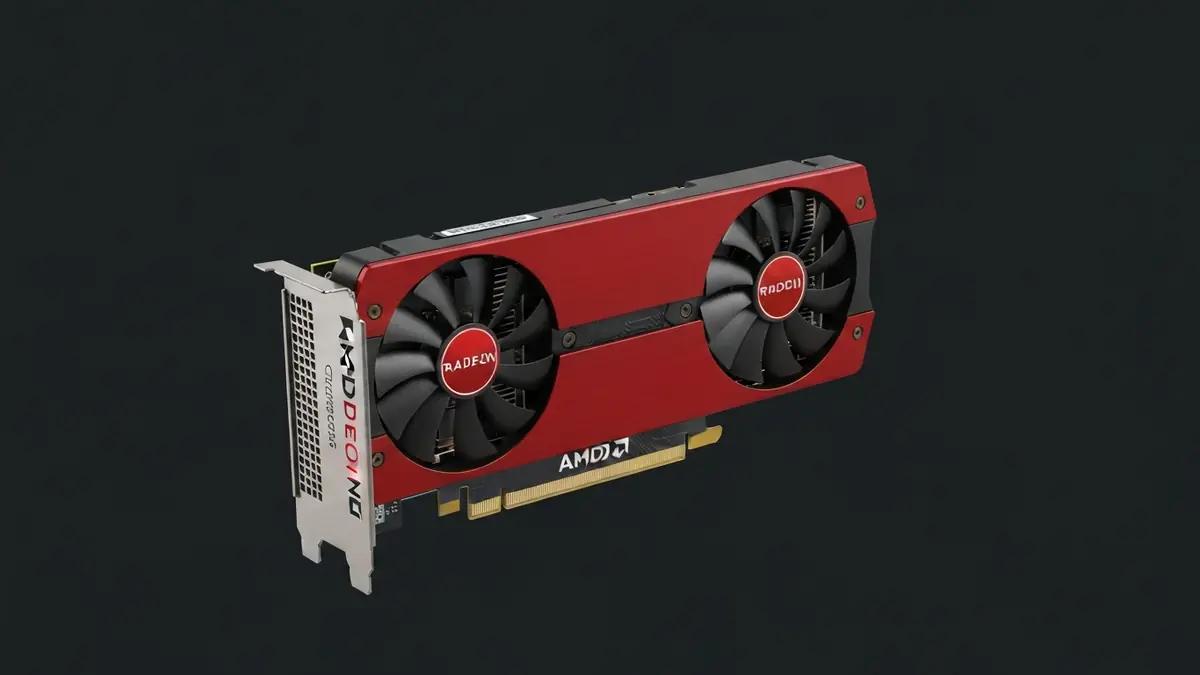
Les 3 points à retenir
- 1RX 9070 XT — The New Upper Mid-Range Champion
- 2RX 9070 — Great Value 1440p Gaming
- 3RX 7900 XTX — The 4K Flagship (~$900)
What is AMD Radeon?
AMD (Advanced Micro Devices) is an American semiconductor company founded in 1969, known for its Ryzen processors and Radeon graphics cards. The Radeon brand dates back to 2000, inherited from AMD's acquisition of ATI Technologies in 2006. AMD is NVIDIA's main competitor in the consumer GPU market.
AMD has traditionally offered better value for money than NVIDIA. With the RDNA architecture introduced in 2019, AMD closed much of the performance gap. The arrival of RDNA 4 in 2025 marks a turning point with vastly improved ray tracing and AI-based upscaling via FSR 4.
For home cinema enthusiasts, video editors, and gamers, Radeon cards offer a compelling and often more affordable alternative to NVIDIA's GeForce lineup.
The 2026 AMD Radeon Lineup
RX 9070 XT — The New Upper Mid-Range Champion
AMD Radeon RX 9070 XT
RDNA 4 architecture with 2nd-gen ray tracing and AI-powered FSR 4. 16 GB VRAM, strong 4K performance, and only 150W TDP. The best performance-per-dollar GPU in 2026 for 1440p and 4K gaming.
The RX 9070 XT is AMD's first RDNA 4 card. Key highlights:
- 2nd-gen ray tracing — 2-3x faster than RDNA 3, closing the gap with NVIDIA
- FSR 4 with AI upscaling — dedicated AI cores for the first time, rivaling DLSS 4 quality
- 16 GB VRAM — more than the RTX 5070's 12 GB, great for high-res textures and video editing
- 150W TDP — excellent power efficiency
RX 9070 — Great Value 1440p Gaming
The RX 9070 (~$500) brings RDNA 4 to a lower price point with 12 GB VRAM. Ideal for maxed-out 1440p gaming.
RX 7900 XTX — The 4K Flagship (~$900)
AMD's most powerful GPU with 24 GB GDDR6 VRAM on RDNA 3 architecture. Built for uncompromised 4K gaming and professional video editing. The 24 GB of VRAM is a huge advantage for DaVinci Resolve users and content creators.
RX 7900 XT — Budget Flagship (~$700)
20 GB VRAM, near-XTX performance for $200 less. A solid choice if you want high-end 4K gaming without paying flagship prices.
RX 7800 XT — The 1440p King
AMD Radeon RX 7800 XT
16 GB GDDR6 VRAM, RDNA 3 architecture. The go-to card for 1440p ultra gaming. Also an excellent choice for a high-end HTPC gaming build.
The most recommended card in the lineup for 1440p gaming. 16 GB VRAM ensures excellent longevity, and it handles 4K at high settings in most titles.
RX 7600 — Budget 1080p Gaming
AMD Radeon RX 7600
8 GB GDDR6, RDNA 3. The perfect entry-level card for 1080p gaming and a great choice for a compact, silent HTPC build.
At ~$250, the RX 7600 is the gateway to PC gaming. Low power consumption (165W) makes it ideal for compact HTPC builds.
RDNA 4 Architecture Overview
RDNA 4 (found in the RX 9070 series) brings three major improvements:
- Redesigned ray tracing units — 2-3x the RT performance of RDNA 3
- AI-powered FSR 4 — dedicated machine learning cores for intelligent upscaling, a first for AMD
- TSMC 4nm efficiency — the RX 9070 XT draws only 150W, dramatically less than equivalent RDNA 3 cards
Radeon for Home Cinema and HTPC
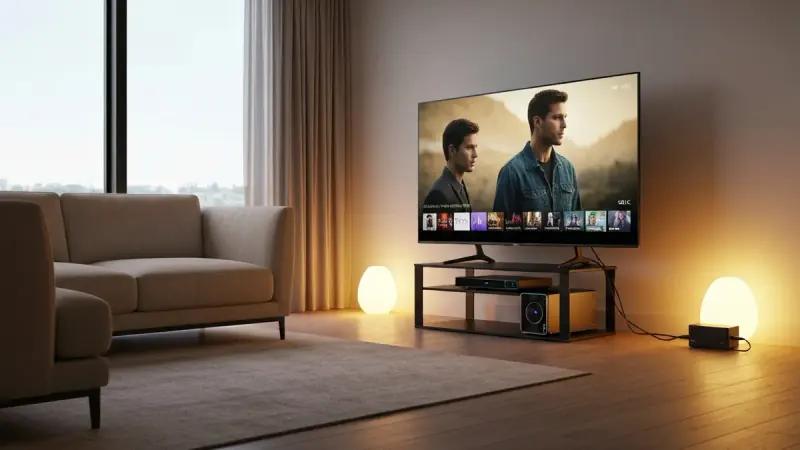
An often-overlooked strength of Radeon GPUs is their excellence as home cinema cards.
Hardware Video Decoding
All modern Radeon cards (RDNA 2+) provide hardware decoding for every major video format:
| Format | Support | Use Case |
|---|---|---|
| H.264 / AVC | Decode + Encode | Blu-ray, standard streaming |
| H.265 / HEVC | Decode + Encode | 4K Blu-ray, Netflix 4K |
| AV1 | Decode + Encode (RDNA 3+) | YouTube 4K, next-gen streaming |
| VP9 | Decode | YouTube 4K |
Hardware decoding means the GPU handles video playback without taxing the CPU, reducing power consumption and heat — perfect for a silent HTPC.
HTPC tip: for a silent 4K HDR media center, the RX 7600 is an excellent choice. Its low TDP and full AV1 hardware decoding make it perfect for playing every video format in 4K without fan noise. Consider a single-fan ITX model for compact cases.
HDMI 2.1 Output
All RDNA 2+ Radeon cards include HDMI 2.1, enabling:
- 4K @ 120Hz output to your TV or projector
- Full HDR support (HDR10, HDR10+)
- VRR for tear-free gaming
- eARC for high-res audio to your AV receiver
HDR Playback on Windows
Radeon cards support HDR output on Windows 10/11. With a compatible display, you can enjoy HDR in MPC-HC/BE with madVR, VLC, Kodi, and all major streaming apps (Netflix, Disney+, Amazon Prime Video).
Driver tip: for the best HDR movie playback experience, use the HDMI output rather than DisplayPort when connecting to a TV. Also make sure to enable HDR in Windows Display Settings before launching your media player.
Radeon for Video Editing
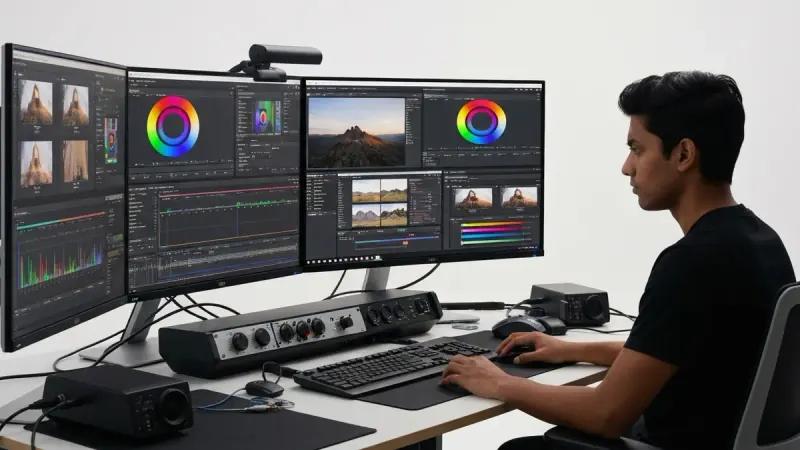
DaVinci Resolve — this is where Radeon cards shine. Resolve uses OpenCL GPU acceleration, and AMD cards are fully optimized. The RX 7900 XTX with 24 GB VRAM is excellent for complex 4K/8K projects.
Adobe Premiere Pro — historically optimized for NVIDIA (CUDA), Premiere has improved AMD support. Performance is now decent, but NVIDIA retains an edge for certain GPU-accelerated effects.
AV1 hardware encoding — RDNA 3 and RDNA 4 cards include a hardware AV1 encoder, enabling fast AV1 exports for YouTube and other platforms.
AMD FSR vs NVIDIA DLSS
| Criteria | AMD FSR 4 | NVIDIA DLSS 4 |
|---|---|---|
| Technology | AI upscaling (RDNA 4) | AI upscaling (Tensor Cores) |
| Hardware required | RX 9070+ (AI), RX 6000+ (spatial) | RTX 20 series+ |
| Visual quality | Excellent (RDNA 4) | Excellent |
| Frame generation | Yes (FSR 3+) | Yes (DLSS 3+) |
| Supported games | 200+ | 300+ |
FSR 4 on RDNA 4 hardware closes the quality gap with DLSS. The advantage of FSR is that it remains open source and works on a broader range of GPUs in its non-AI version.
Radeon vs GeForce Comparison
| AMD Model | Price | NVIDIA Model | Price | Verdict |
|---|---|---|---|---|
| RX 9070 XT | ~$600 | RTX 5070 | ~$650 | Radeon: better value, more VRAM |
| RX 7900 XTX | ~$900 | RTX 4080 Super | ~$950 | Radeon: 24 GB vs 16 GB VRAM, close performance |
| RX 7800 XT | ~$450 | RTX 4070 Super | ~$500 | Radeon: more VRAM, lower price |
| RX 7600 | ~$250 | RTX 4060 | ~$280 | Very close, Radeon slightly cheaper |
Overall, AMD offers more VRAM at equivalent prices and better raw value. NVIDIA retains advantages in ray tracing (outside RDNA 4), DLSS ecosystem, and professional software compatibility (CUDA).
How to Choose Your Radeon Card
By Gaming Resolution
- 1080p: RX 7600 (~$250) — high performance on a budget
- 1440p: RX 7800 XT (
$450) or RX 9070 ($500) — the sweet spot - 4K: RX 9070 XT (
$600) or RX 7900 XTX ($900)
By Budget
- Under $300: RX 7600, perfect for 1080p gaming and HTPCs
- $300-$600: RX 7800 XT or RX 9070 XT, the best balance
- $600+: RX 7900 XTX for maximum VRAM and 4K ultra
Pros and Cons of AMD Radeon
Pros
Cons
Conclusion
AMD Radeon graphics cards have never been more competitive than in 2026. RDNA 4 addresses AMD's two historical weaknesses — ray tracing and AI upscaling — while retaining the brand's core strengths: more VRAM, better value, and open-source commitment.
For home cinema enthusiasts, Radeon is a natural choice. Full hardware decoding (AV1, HEVC, VP9), HDMI 2.1 output, and HDR support make any recent Radeon card an excellent HTPC GPU. Low-power models like the RX 7600 are particularly well-suited for compact, silent builds.
For gaming, match your card to your resolution and budget: RX 7600 for 1080p, RX 7800 XT or RX 9070 for 1440p, and RX 9070 XT or RX 7900 XTX for 4K. AMD has a card for every use case and every budget in 2026.

À propos de l'auteur
Sophie Laurent
Experte high-tech & audio
Ingénieure de formation, Sophie décrypte les technologies audio et vidéo pour vous aider à choisir le meilleur équipement selon votre budget.
You Might Also Like
4K Resolution: Complete Guide to UHD, HDR and Everything You Need to Know
Everything about 4K resolution — UHD explained, HDR formats, HDMI 2.1, viewing distance, 4K sources. The definitive guide for home cinema and gaming.
Mini PC: Complete Guide 2026 — Best for Home Cinema and Desktop
Everything about mini PCs — best models for HTPC, desktop and media center. Intel NUC, Beelink, Minisforum, Mac Mini: the complete buyer's guide.