Marantz Cinema 70s Review: The AV Receiver That Puts Sound Quality First

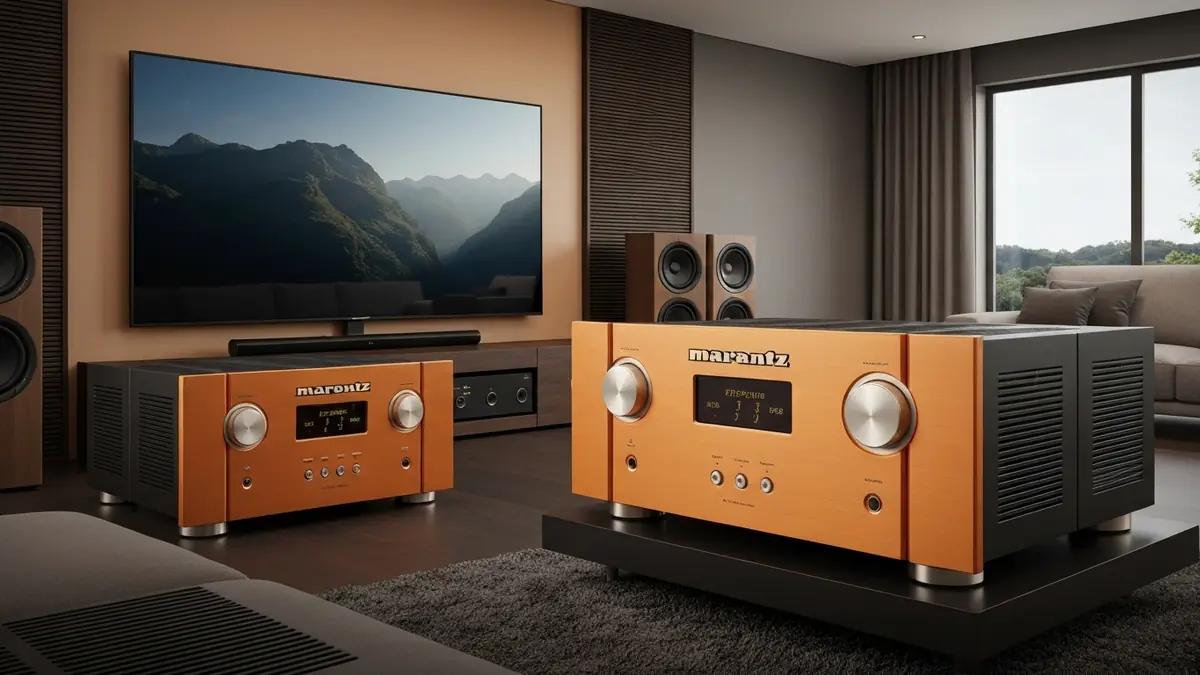
Les 3 points à retenir
- 1The Slim Profile
- 2Brushed Aluminum and the Porthole
- 3What Makes Marantz Different From Denon
The AV Receiver for People Who Refuse to Choose Between Cinema and Music
The Marantz Cinema 70s looks like it shouldn't work. At 50W per channel (8 ohms, all channels driven), it seems underpowered. At 7.2 channels with only native 5.1.2 Dolby Atmos, it seems outgunned by the identically-priced Denon AVR-X3800H and its 9.4 channels. At just 5.2 inches tall, it seems too slim to be taken seriously.
And yet, after four months of daily use, the Cinema 70s has become our favorite AV receiver to actually listen to. Because specs tell one story, and sound quality tells another.

Marantz Cinema 70s
7.2-channel AV receiver with a warm, musical sound signature, slim premium design, and full Dolby Atmos support. Audyssey XT32, HEOS, phono input, HDMI Zone 2.
Design: Premium in Every Detail
The Slim Profile
At 13.3 cm (5.2 inches) tall, the Cinema 70s fits where other receivers simply don't. Standard AV receivers are typically 6.5 to 7 inches tall. Those two inches matter enormously when you're trying to fit a receiver into a media console, an IKEA Besta unit, or a wall-mounted shelf. The Cinema 70s slides in with room to spare.
Brushed Aluminum and the Porthole
The front panel is genuine brushed aluminum — not painted plastic. The tactile difference is immediate and significant. Buttons are smooth and precise. The iconic Marantz porthole display — a circular window showing volume and source information — gives the Cinema 70s a character that no other AV receiver matches. It's a design legacy dating back to the 1950s, and it still works.
The slim chassis runs warm under sustained use. Leave at least 2 inches of clearance above and on the sides. In enclosed cabinets, consider a quiet USB fan (AC Infinity makes excellent options).
Key Specifications
- Channels: 7.2 (5.1.2 Dolby Atmos native, expandable to 7.2.4 with external amp via pre-outs)
- Power: 50W per channel (8 ohms, all channels driven) — real-world performance closer to 70-80W
- Formats: Dolby Atmos, DTS:X, IMAX Enhanced, Auro-3D
- HDMI: 6 HDMI 2.1 inputs (8K/60Hz, 4K/120Hz), 2 outputs (1 main + 1 Zone 2)
- Room correction: Audyssey MultEQ XT32
- DAC: ESS Sabre ES9016
- Streaming: HEOS, AirPlay 2, Bluetooth, Spotify Connect, Tidal Connect, Amazon Music
- Pre-outs: Full 7.2 for external amplification
- Phono input: Yes
- Zone 2: HDMI output (video + audio)
The Power Question: Is 50W Enough?
Marantz rates the Cinema 70s conservatively — 50W per channel with all channels driven simultaneously. Most competitors measure with one or two channels driven, inflating their numbers. In real-world use, the Cinema 70s delivers 70-80W per channel in stereo mode.
For the majority of home setups with speakers of normal sensitivity (85-90 dB) in rooms up to 300 square feet, 50W is genuinely sufficient. You'll run out of room before you run out of power.
Where it becomes a limitation: very large rooms, very inefficient speakers, or reference-level playback (85 dB reference + 20 dB headroom). For those scenarios, the full 7.2 pre-outs let you add an external power amplifier — transforming the Cinema 70s into a capable preamp/processor that can drive virtually any speaker.
Sound Quality: The Marantz Signature
What Makes Marantz Different From Denon
Marantz and Denon share the same parent company (Masimo, formerly Sound United), the same platform, the same Audyssey XT32, the same HDMI 2.1 chipset. The difference is in the voicing.
Denon is analytical, precise, clinical. It reveals every detail with unflinching transparency. Marantz is warmer, more musical, more "analog." High frequencies are gently smoothed, midrange is fuller and more present, voices gain body and naturalness. It's a receiver that prioritizes listening pleasure over pure accuracy.
Neither approach is objectively better. But if you listen to music as much as you watch movies, the Marantz signature has a clear advantage: it never fatigues. Hours of jazz, classical, or rock pass without harshness, without treble bite, without the subtle listening fatigue that analytical receivers can produce over time.
Cinema Performance
Dialogue is the Cinema 70s's strongest suit. Voice clarity, timbral accuracy, center channel separation — all excellent. Whispered conversations in The Zone of Interest, Cillian Murphy's monologues in Oppenheimer, the layered dialogue in Killers of the Flower Moon — all reproduced with warmth and precision.
Dolby Atmos in 5.1.2 is convincing with proper ceiling or Atmos-enabled speakers. Height effects in Dune: Part Two — ornithopters overhead, sand cascading — are credible and add genuine spatial dimension. The limitation compared to a 7.1.4 setup is real but less dramatic than you might expect in rooms under 250 square feet.
Music: Where the Cinema 70s Shines Brightest
The ESS Sabre ES9016 DAC is a hi-fi-grade converter. In Pure Direct mode with all processing bypassed, the Cinema 70s delivers musicality that surprises for an AV receiver. The stereo soundstage is wide and airy, instruments are well-separated, and the tonal balance is rich without being colored.
The built-in phono input is a rare and valuable feature. Most AV receivers require an external phono preamp to connect a turntable. The Cinema 70s eliminates that extra box. The integrated phono stage isn't audiophile-grade, but it's perfectly pleasant for daily vinyl listening with a mid-range turntable.
HEOS streaming covers all the bases — Tidal Connect, Spotify Connect, Amazon Music, AirPlay 2, Bluetooth. High-resolution streaming via Tidal HiFi takes full advantage of the ES9016 DAC.
Audyssey MultEQ XT32
The Cinema 70s includes the top-tier Audyssey — the same MultEQ XT32 as the Denon AVR-X3800H. This is a significant advantage over cheaper receivers that only include basic MultEQ. The XT32 applies vastly more correction filters, especially in the bass region where room problems are most severe.
Spend the ~$20 on the Audyssey app (iOS/Android). It offers far more control over the target curve, correction range, and bass management than the built-in calibration wizard.
Connectivity Highlights
Six HDMI 2.1 inputs cover PS5, Xbox Series X, Apple TV, streaming boxes, and Blu-ray players with room to spare. Full 4K/120Hz with VRR and ALLM for gaming.
HDMI Zone 2 is a standout feature. Most receivers offer only analog Zone 2 (audio-only to extra speakers). The Cinema 70s sends full HDMI video and audio to a second TV in another room. Someone watches a Dolby Atmos movie in the living room while someone else watches a different source in the bedroom — with picture and sound.
Vs the Competition
| Feature | Marantz Cinema 70s | Denon AVR-X3800H | Denon AVR-S770H | Anthem MRX 540 |
|---|---|---|---|---|
| Price | $1,299 | $1,299 | $499 | $2,499 |
| Channels | 7.2 (5.1.2 native) | 9.4 (7.1.4 native) | 7.2 (5.1.2 native) | 5.2 (expandable) |
| Power | 50W/ch | 105W/ch | 75W/ch | 100W/ch |
| Room correction | Audyssey XT32 | Audyssey XT32 | MultEQ (basic) | ARC Genesis |
| Phono input | Yes | No | No | No |
| HDMI Zone 2 | Yes | No | No | No |
| Design | Slim, premium | Standard | Standard | Standard |
| Sound signature | Warm, musical | Analytical, precise | Adequate | Neutral, precise |
vs Denon AVR-X3800H ($1,299)
Same price, same parent company, same platform. Choose the Denon if you want maximum Atmos immersion — 7.1.4 native, 105W per channel, more channels of height. Choose the Marantz if you want the best sound for music AND cinema, care about design, need a phono input, or want HDMI Zone 2.
vs Denon AVR-S770H ($499)
The S770H is great value, but the Cinema 70s is in a different league. Audyssey XT32 vs basic MultEQ, full pre-outs, phono input, HDMI Zone 2, ESS Sabre DAC, and noticeably superior sound quality justify the price jump for those who can afford it.
vs Anthem MRX 540 ($2,499)
The Anthem offers ARC Genesis — arguably the best room correction available — and superior amplification. But it costs nearly double, lacks HEOS streaming, and its design is purely utilitarian. The Marantz is the balanced choice; the Anthem is for purists willing to pay for raw performance.
Who Should Buy It
Pros
Cons
Buy it if you want cinema and music from the same receiver, own a turntable, care about design, need HDMI Zone 2, or prefer warmth over analytical precision.
Skip it if you need native 7.1.4 Atmos (get the Denon AVR-X3800H), you're on a budget (get the Denon S770H at $499), or you prioritize raw power over sound refinement.
The Verdict
The Marantz Cinema 70s isn't the most powerful receiver at its price. It isn't the one with the most native Atmos channels. But it's the one that sounds the best — the one you'll enjoy listening to for hours, whether you're watching Dune in Dolby Atmos, streaming Miles Davis in hi-res, or spinning vinyl on a Sunday morning.
At $1,299, it's for those who understand that audio quality isn't measured in watts alone. It's for the music lovers, the vinyl enthusiasts, the design-conscious buyers who want their home theater to sound as good as it looks.
Final score: 8.5/10 — The most musical and elegant AV receiver in its class, with honest tradeoffs on power and native channel count.

À propos de l'auteur
Sophie Laurent
Experte high-tech & audio
Ingénieure de formation, Sophie décrypte les technologies audio et vidéo pour vous aider à choisir le meilleur équipement selon votre budget.
You Might Also Like
Dolby Atmos at Home: A Complete Setup Guide
Everything you need to know about bringing immersive Dolby Atmos audio into your home theater — from equipment choices to room configuration and budget planning.
Denon: Complete Guide to Home Cinema Receivers and HiFi in 2026
Everything about Denon — AVR-S770H, AVR-X3800H home cinema receivers, soundbars, and turntables. Buyer's guide, comparison, and complete review of the Denon range.
Best Dolby Atmos Soundbars in 2026: Complete Buyer's Guide
Our picks for the best Dolby Atmos soundbars in 2026 — from the Sonos Arc to the Sennheiser Ambeo Max, tested and compared for your home theater.